I ask that you to let go of your current understanding of Faith for just the time you take to read this post. Discover faith again as we explore the meaning, power, and use of it in everyday life. This may be hard, so picture yourself exploring a new people. Let's choose the ancient Greeks where thought began to derive logic and science. You are going to explore a tiny bit of their language. You are going to journey with them to find truth and discover this was their ultimate goal. You will find that they began to search for natural answers to things instead of assigning all misunderstood happenings to mythological or divine interventions. Science was born at this time and mankind began to look at the world with new eyes. This started at the end of the 5th century B.C. People such as Socrates, Pythagoras, Plato, Anaximander, Anaximenes of Miletus, Aristotle, Thales of Miletus, Diogenes, Parmenides, Plutarch, Xanophanes, Archimedes, (and many more), began to arise and give reason and measure to the world around them. They sought knowledge in everything around them. When it was said, "the gods made it so," they set out to discover what natural phenomena was going on to cause such a thing.
At the Eastern Division Meetings of the American Philosophical Association in December of 1988, a speech was given by Peter Losin called 'Plato's Analogy of the Divided Line.' 'The Divided Line' is a conversation written by Plato within 'The Narrative of the Republic' describing 4 levels of reality or truth. Plato was trying to decipher what is knowledge and what is truth. He steps aside from moral grounds (defining what is right and wrong according to culture or belief) and tries to define reality. We can place what we know (believe) into these four categories to help us understand if our knowledge is founded upon truth or conjecture. The four categories are Noesis, Dianoia, Pistis, and Eikasia. The image below is a pictoral representation of what he wrote. They are ordered from the worst type of knowledge (Left) to the best/most complete knowledge (Right).
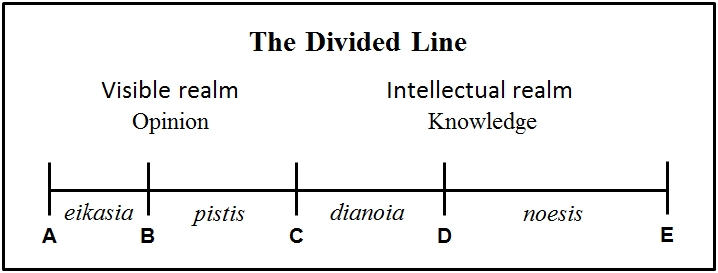
(Image retrieved from HERE)
To better give understanding to this chart, here is another chart I made that defines these Greek words into what they mean and their uses:

Look at the word 'Pistis'. Eikasia is studying the tree through a picture or shadow or reflection of it while pistis is the actual tree being observed. When a person was being convicted in court, the prosecutor needed pistis or evidence to prove guilt. The defendant needed pistis or evidence to prove innocence. Lawyers and politicians use Dianoia to reason and give thought beyond what people see (true or not) and Noesis is the judgement given by the judge after exhausting all evidence (or pistis).
In the New Testament, Pistis is the Greek word that translates into Faith. How does that compare to your current definition of Faith? It is far from a belief in something one cannot see or touch or measure. That is Eikasia knowledge. Pistis knowledge is something one can see and measure. Dianoia is what one does after they see the object of knowledge try to discern why or how it happened. Noesis is gained when a complete understanding is gained of that object. Religiously, Elkasia is belief in a God that is unknown. Pistis is seeing God or hearing him or interacting with him. Dianoia is beginning to comprehend the nature of God to help define morals and truths. Noesis is knowing God's will and absolute truth.
Lets turn to the scriptures. The King James version of the Old Testament has the word 'Faith' twice. It was translated from Hebrew. Now look at the New Testament, translated from Greek, where 'faith' appears 229 times. Did the Gospel change? Was faith not as important before Christ? The Book of Mormon has the word 'faith' 223 times. Most of those were before Christ was born. Where is "Faith" in the Old Testament? According to the Book of Mormon and Paul (Hebrews 11) and other New Testament authors and even Christ Himself, faith was very much a part of God's dealings with mankind in the past just as much as it is today.
Finding out God or faith is different than our perceptions is moving from Eikasia knowledge (looking at shadows to understand things) to Pistis Knowledge (Seeing the thing itself). Comprehending God is Noesis. According to the experts (prophets before us) man cannot comprehend God (Romans 11:33-36 & Mosiah 4:9), therefore, Noesis of God is not something we can attain unto on our own. It takes revelation. And luckily, there is a lot of revelation given concerning God and Faith that we can rely upon to find out what Faith really is.
Here is a link to Chapter 13 of the 'Doctrines of the Gospel Student Manual'. It has a great list of scriptures that show the use, definition, purpose, and examples of faith. It is not exhaustive but has a good list. Please read them. It's not long.
 |
| Hebrews 11:1 |
 |
| JST Hebrews 11:1 |
I find it neat that Joseph Smith was right in his correction. The greek word translated to substance is a mistranslation if one thinks of earth or matter or something one can touch. Referring to Strongs Concordance of the Greek New Testament (Strongs concordance identifies English words translated from Greek words in the New Testament. It references how often a Greek word was translated that way and it references other words it was translated into as well. It is a powerful source to understand the meanings of Greek words) the Greek word is 'upostasij'. A snipit of this words use is here:

Sounds like faith is being defined exactly as Plato defined Pistis. And if faith is the concrete, foundational, evidence, assurance, real substance, of things hoped for, the evidence of things not seen... what does that mean? A quick read of the rest of the verses in Hebrews 11 will show that each person received a promise from God in something they sought for, then did what God told them to do to gain it, and gained it. Once they had gained it, their work was over. Meaning, their faith was done in that hope. They had gained the realization of their faith. So the assurance was evidence from God that they could obtain what they hoped for. It was pistis.
In this light, to say, "my faith is strong because I go to church every Sunday" or "my faith in God is my own making" does not make sense. This is confusing faith with the word belief. "I believe in God so I keep His commandments" makes sense, not "I have faith in God so I keep His commandments". If some one says they have faith in God, I should be able to ask, "What is it you are hoping for and when did God say you could have that thing you hope for and what are the things He has asked you to do to gain it?" Any one of those things missing, and you have no faith to exercise. Doesn't mean you have no testimony or belief or knowledge. Just means you have no Divine purpose at this time.
The founding fathers of America used the term, "Divine Providence" or just "providence." It meant to have a purpose or work to do under the direction of God. They believed one must have providence or they would be lost in life, purpose, and duty. They believed that what they were doing was commissioned to them by God and nothing could stop it. Indeed, nothing can stop faith in God.


They knew from experience how faith works, they just called it by a different name, Providence. And this providence gave them conviction that what they were doing was right and God's will. They prayed for instruction and guidance and did as they were inspired.
If you read Hebrews 11, you find the same pattern. The passages of scriptures that helped me to learn what faith really is were found in Nephi 32:1-6, Moroni 7, and Hebrews 11.
The adage, "The first law of heaven is obedience" is often construed to replace faith. What Bruce R. McConkie defined when he wrote this in 'Mormon Doctrine' is faith, not just obedience. He wrote:
"Obedience is the first law of heaven, the cornerstone upon which all righteousness and progression rest. It consists in compliance with divine law, in conformity to the mind and will of Deity, in complete subjection to God and his commands." Mormon Doctrine Pg 539.
Faith is a type of obedience, but an obedience that requires constant revelation and direction from God. This phrase has been construed to mean that obedience is faith. It is not. This has led people to declare, "If the prophet says for me to do it, then I do it without question." With dignity and honor they obey. Today, there seems to be a movement of great force within the church to counter this harmful belief by teaching blind obedience is bad. The problem is they didn't read the rest of the quote as given above. Obedience, as Elder McConkie defined it, requires submission to the will of God which would require a great deal of revelation to do anything right. Hence, his obedience as he defined is the same as faith.
Obedience as simply obedience is a part of faith but it is not faith, just as much as belief is not faith. Belief is a part of faith.
Saul believed that the saints were wrong and evil and killed and destroyed them. When God came to him and he was converted, he then had a change in belief and began to do a different work. His beliefs changed and his obedience changed and then he began to exercise faith in Christ. The same goes for Alma the Elder and Alma the younger. Their stories of conversion show that belief does not save. Their concern for their own souls was real and heavy and they hoped that their work was sufficient to save them. They were working on a faith to be cleansed from their pasts. Hence, though they knew the atonement of Christ is sufficient to save, their belief was not enough to save them yet they knew that through faith they could be saved. Belief is not faith.
Another example, the Jews were so hung up in obedience to law that the law became their savior. The laws God gave were not comprehensive, they were principles and therefore this presented a problem for knowing if one was righteous or wicked, clean or unclean. A few examples are keeping the sabbath day holy, honor thy father and mother, do not marry thy kindred, pay tithe, etc. Notice how the law was vague? How to keep those laws was left to the person. The Jews took it upon themselves to create the subset of laws to help govern people so they knew how to keep those laws. This replaced the most key element in faith. They were being obedient to their laws, but were far from God and the truth. Obedience in itself is not going to save anyone from death and hell. Obedience is not faith.
The key element that was covered up in law was revelation. Personal revelation and prophetic revelation. The first more important than the latter.
Nephi acted in faith when he declared his knowledge that he knew God would provide a way for him to accomplish the things he was commanded to do. So he went. Laman and Lemuel were not so willing but went probably because Nephi and Sam were younger and needed their aid. Straws drawn, Laman went to visit King Laban. Was this God's will? Was drawing straws the way God wanted them to obtain the plates of brass? In any case, it didn't work. Laman and Lemuel willing to give up and go home, Nephi preached to them the words of the prophets and their father that Jerusalem would be destroyed and they would too if they didn't have this record. He convinced them to gather their precious things back home and go back to Laban and try to get the plates again. Nephi was most likely inspired to do this. So they did it and it resulted in them almost loosing their lives. Was this how God wanted Nephi to get the plates? We might conjecture yes or no but after the angel visits them and instructs Laman and Lemuel, Nephi has got to have some serious questions. I imagine him saying things like, "What is happening? I thought you would provide a way for us to get this done. Why is nothing working? I knew what I was supposed to do but it didn't work, why?" But Nephi recalls that he went alone as instructed by the Spirit and followed the spirit in every step not knowing beforehand what he was to do. He was literally walking in faith. He was being led by revelation. He slew Laban and gained his sword and clothing, and also brought Zoram back with him.
Step back a minute and consider, would you have ever guessed God would want you to kill Laban, get his sword and clothes, get the plates and Zoram? A fun question to ask is, "would Laban be found drunk if he hadn't have gained a substantial amount of wealth from Lehi's home?" or "What would have Laban done had he not been killed and found his plates gone?" Would God even command his death if he hadn't tried to kill them for their wealth? All in all, things worked out and Nephi accomplished the work given to him and he received many miracles along the way that gave him evidence, proof, and witness that God is real, loves him, and cares.
Now zip forward to Nephi's death bed. He is giving his last sermon in writing and it is concerning the doctrine of Christ. In Chapter 31 of 2 Nephi, he talks of a gate and the straight and narrow pathway to heaven. The gate is repentance, baptism and the baptism of fire through the Holy Ghost. That is the gate to the path. Once on the path you can speak with the tongue of angels and shout praises to the Holy One of Israel (all made possible through the Holy Ghost) and to continue on the path one must endure to the end with unshaken faith in Christ. The path leads us to eternal life. Faith leads us to eternal life.
In chapter 32 he gives again the doctrine of Christ but in an entirely different way. He skips the gate and goes on to explain what enduring to the end in faith means while on the path. He explains it as feasting on the words of Christ which TELL you all that you should do, asking and knocking about those things or you'll perish no matter how much you study the gospel, and then the Holy Ghost will show you HOW to do those things you were told to do while feasting on the words of Christ. In both descriptions, he claims this is the doctrine of Christ. In the second one, he declares there would be no more doctrine given until He (Christ) shall manifest Himself unto you in the flesh.
In chapter 31 Nephi tells us to enter the pathway that Christ used to show obedience and faith in God. The gate he describes is the beginning of this straight and narrow path. The gate is repentance, baptism, and the companionship of the Holy Ghost. Listen to what Nephi says about the Holy Ghost...
"17 Wherefore, do the things which I have told you I have seen that your Lord and your Redeemer should do; for, for this cause have they been shown unto me, that ye might know the gate by which ye should enter. For the gate by which ye should enter is repentance and baptism by water; and then cometh a remission of your sins by fire and by the Holy Ghost.
"18 And then are ye in this strait and narrow path which leads to eternal life; yea, ye have entered in by the gate; ye have done according to the commandments of the Father and the Son; and ye have received the Holy Ghost, which witnesses of the Father and the Son, unto the fulfilling of the promise which he hath made, that if ye entered in by the way ye should receive." (2 Nephi 31:17-18)
Notice the Holy Ghost witnesses of God unto the fulfilling of the promise. This is faith! The promise is not gained by passing through the gate of baptism. It is earned through enduring faith on this path until you have gained them. Hence Nephi continues to explain that faith is required on this path and then defines faith...
"19 And now, my beloved brethren, after ye have gotten into this strait and narrow path, I would ask if all is done? Behold, I say unto you, Nay; for ye have not come thus far save it were by the word of Christ with unshaken faith in him, relying wholly upon the merits of him who is mighty to save.
20 Wherefore, ye must press forward with a steadfastness in Christ, having a perfect brightness of hope, and a love of God and of all men. Wherefore, if ye shall press forward, feasting upon the word of Christ, and endure to the end, behold, thus saith the Father: Ye shall have eternal life.
21 And now, behold, my beloved brethren, this is the way; and there is none other way nor name given under heaven whereby man can be saved in the kingdom of God. And now, behold, this is the doctrine of Christ, and the only and true doctrine of the Father, and of the Son, and of the Holy Ghost, which is one God, without end. Amen." (2 Nephi 31:19-21)
The first 6 verses in chapter 32 are a re-writing of the last 4 verses in chapter 31 to help people understand what they have to do after they have entered onto the straight and narrow path. (These next 6 verses are from 2 Nephi 32)
"1 And now, behold, my beloved brethren, I suppose that ye ponder somewhat in your hearts concerning that which ye should do after ye have entered in by the way. But, behold, why do ye ponder these things in your hearts?
2 Do ye not remember that I said unto you that after ye had received the Holy Ghost ye could speak with the tongue of angels? And now, how could ye speak with the tongue of angels save it were by the Holy Ghost?"
He reminds us that we have the power of the Holy Ghost with us. That we can use this on this path. The companionship of this God is critical to the work we have to do on this path.
"3 Angels speak by the power of the Holy Ghost; wherefore, they speak the words of Christ. Wherefore, I said unto you, feast upon the words of Christ; for behold, the words of Christ will tell you all things what ye should do."
This has multiple implications. One, that we can search the scriptures or words of the prophets for God's will for us individually. Two, that we have the power within us (so long as we have the companionship of the Holy Ghost) to speak the words of Christ for ourselves (AKA receive God's commands through personal revelation). It is important to note that these revelations will tell you what to do. Things like keep the sabbath day holy, or pay ten percent of your increase annually, or give thanks to God day and night, etc. I have found it gets even more specific such as, stop your car and wait, or knock on this persons door and offer them your service, or call this person, or repent and change this in your life.
"4 Wherefore, now after I have spoken these words, if ye cannot understand them it will be because ye ask not, neither do ye knock; wherefore, ye are not brought into the light, but must perish in the dark."
This verse really puts knowledge in it's place. Knowledge cannot save anyone. Not even Satan was saved with all he knew. We can search the scriptures for an eternity but unless we ask and knock (Pray and do the things we are shown to do) we will not be brought into the light.
"5 For behold, again I say unto you that if ye will enter in by the way, and receive the Holy Ghost, it will show unto you all things what ye should do."
Here is the kicker of righteousness. You can try to be obedient but without revelation, you are not obedient to God's will, just your own understanding of His will. We must all rely upon God to show us His will through the Holy Ghost, a person and a God who knows all and is able to show us anything we need and want. Once we know what to do and how to do it, we can act in faith on this path and endure to the end to gain eternal life.
"6 Behold, this is the doctrine of Christ, and there will be no more doctrine given until after he shall manifest himself unto you in the flesh. And when he shall manifest himself unto you in the flesh, the things which he shall say unto you shall ye observe to do.
7 And now I, Nephi, cannot say more; the Spirit stoppeth mine utterance, and I am left to mourn because of the unbelief, and the wickedness, and the ignorance, and the stiffneckedness of men; for they will not search knowledge, nor understand great knowledge, when it is given unto them in plainness, even as plain as word can be.
8 And now, my beloved brethren, I perceive that ye ponder still in your hearts; and it grieveth me that I must speak concerning this thing. For if ye would hearken unto the Spirit which teacheth a man to pray, ye would know that ye must pray; for the evil spirit teacheth not a man to pray, but teacheth him that he must not pray.
9 But behold, I say unto you that ye must pray always, and not faint; that ye must not perform any thing unto the Lord save in the first place ye shall pray unto the Father in the name of Christ, that he will consecrate thy performance unto thee, that thy performance may be for the welfare of thy soul."
And there it is again. Pray to know God's will, to know what he wants you to do. To know what to hope for that you may have faith in God and gain His wonderful blessings He has waiting for you. Notice that when we pray, our actions are consecrated for our good and the welfare of our souls. This is faith. It is being led by Rebekah in your daily walk to obtain the hopes and desires you and God have counseled over in prayer.
To sum up, faith has some key elements that I have found throughout the examples and teachings on faith in the scriptures:
- Prayer: Talk to God about your desires; what you hope for. Seek for things which are good and true and you know are right.
- Revelation: The answer to that prayer (or many prayers) will be a promise or assurance that what you seek for is OK to seek for. That you can have that thing. It is not realized yet and therefore you have an assurance in something you hope for, the evidence of things not seen. Faith can now begin.
- Prayer: Faith continues as you seek God's will in obtaining that hope you have an assurance for.
- Revelation: You will receive more revelation about what to do to gain that assurance.
- Act: Do as you are instructed. Do it God's way, not your way. If you cannot answer the question, "How has God instructed you to do that?" then you are not acting in faith and your faith is dead. You have become a law unto yourself and will fall. You must submit to God and exercise faith in Christ through constant revelation and inspiration in how to act and get this work done.
- Repeat steps 3 through 5 until you have gained the hope you sought for. (Hebrews 10:36)
- Witness the miracle!
- Give thanks.
A great example is Joseph Smith Jr. when he learned about baptism in the Book of Mormon. He wanted to be baptized and learned it was required. He could have just ran to a river and said the same words Alma did or repeat the words given by Moroni on how they baptized. He could have dunked himself at the same time as dunking Oliver Cowdery and it would have been according to what he was told in scripture. Would it be right? We know today that he lacked priesthood authority and authorization to baptize. It would not be OK. It would not be faith either because it would beget no miracle and because it would not be done according to God's will. Hence, Joseph, already practiced in acting in faith, went in prayer and asked God if he and Oliver could be baptized. The answer came, angels ministered, power was given, and their faith answered with a miracle of being baptized and empowered to baptize others. They gained the hope they sought for.
I have discovered that God will require me to do things different than my neighbor in order to keep the same commandments we have both been given. We cannot judge, nor can we assume the will of God. We must seek for his will in all things and do it. Abraham sought for the same blessings as his fathers but he nor any of his fathers did the same thing to gain that same blessing.

Remember, it is by faith in small things that we gain the faith to save our souls. The words of Christ inspire us to know what it is we can and should hope for. The gift of the Spirit we obtained at baptism will invoke within us the knowledge of what we should hope for and how to go about doing it.

To help give examples of simple ways to exercise faith I tried this with my daughter. Back in May, she got into a car accident. Both cars were totalled. Her experience left her with extreme anxiety which I've the past months grew until her neck muscles wouldn't let her turn her head and her fear of driving was extreme and she wouldn't drive.
Her loyalty outweighs her fear still so one day she drove to work because I and her mother were on a date together. A little past ten at night we get a text that she needs help driving home. So we stopped by her work and I got into her car with her. She started to drive and quickly discovered she was avoiding all left turns and taking us in a strange direction to do so. I had pull the car over and we talked. She believed her fear to be superior to anything. When I told her she was going to take only left turns to get home, she panicked. She was convinced it was going to take months and years to get over this. I helped her see that she obtained this fear in an instant and our minds, bodies, and hearts are able to change as quickly in any direction. She wasn't convinced. So I suggested we try out faith as I explained it to her just the Sunday before. So we prayed. I asked God if Ella could take only left turns and make it home without scratch, dent, or harm. After the prayer the Spirit filled our hearts.
"Do you feel the Spirit?" I asked. "Yeah," she replied. "Do you feel better?" I asked again. "Yeah," she responded. "See, you can feel better in an instant." I smiled. She retorted, "but I still have fear dad. It only feels a little better." " OK. But you do feel it and now you know, God has given us an assurance that what we hope for is ours to have. We can take all left turns and you know nothing will happen. You have nothing to fear." I said and she listened. So we drove. At each turn, I asked how she felt and at each turn she felt better. The cat kept filling with the power of the Spirit of God until she we got home we stopped in the driveway and sat there. "How do you feel Ella?" I asked. "Really good dad." "You just exercised faith Ella. You had a hope, gained an assurance, and did as you were instructed and now have witnessed the miracle. You got home safely and you feel better." I was elated. She then asked, "So am I supposed to pay every time I drive?" She asked sincerely. "I would hope that one day you won't need to but if you need it, yes you can."

Notice how this scripture was fulfilled in my example. In the very hour of need, I and my daughter were able to rely Yoon or pay choices to study the scriptures together, really upon inspiration or the words of Christ in a teaching about faith, and then practice it which brought pistis or knowledge and evidence that it works. Or faith was restored in that moment.
There are so many other examples of faith. When you see a miracle, you know faith was used. Look for that faith and the ingredients of it. Please study Hebrews 11 and Moroni 7 because they will show you that it is within your power to ask God for anything and you can obtain a perfect brightness of hope and gain the most desired blessings. It is a pathway, not an event. It will take endurance, not indifference. It will take a keen eye and heart to know the imperfections of your actions and the humility to change them so you can be faithful and live righteously and enjoy the fruits of faith.
There is another common belief that I did not list at the beginning because it is had amongst many saints and I did not want to distract from the message. It is the belief that if one knows something then they cannot have faith in that thing anymore because they know it and they believe that faith requires a lack of knowledge. Hence I was taught in my youth that if Christ was standing in front of me, I could not act in faith. This was the purpose of the veil. This would assume that testimonies overcome faith. Hence if I had testimony in Christ, I should not have to exercise faith anymore. This is false and contains bits of truth mixed with Eikasia knowledge (assumptions of shadows of things they knew existed but didn't understand). Another example is that if I knew that I would not get a scratch in a car wreck that was about to happen, I couldn't act in faith because I already knew what was going to happen. This is wrong. I believe it is derived from the truth that faith begets testimony and knowledge and that when one gains the knowledge or testimony they sought they no longer need to act in faith for that thing. It is false in assuming knowledge destroys the ability to exercise faith. Knowledge can actually make faith a lot harder, such as knowing a people will burn you alive or stone you if you go back to preach to them. Knowledge is required to have something to hope for. If you don't know you can hope for something, then you lack knowledge to gain it. Then it takes more knowledge to know God will allow you to gain it. Then it takes more knowledge to know what to do to gain it. Knowledge is so much a part of Faith that there is no way to separate them. Men, Prophets, and Angels act in faith and many of them have knowledge superior to ours. Even the God's act in faith excepting God the Father who is the creator of the laws and sits above all to give to all according to their faith in Him. If Christ acted in faith (Hebrews 10:37-38;12:2, 2 Nephi 31:15) on this earth being a God, then a lack of knowledge or heaven is not needed to have faith. Testimonies are gained through faith. The faith we have been walking ends when we gain the testimony (A.K.A. miracle) it was based upon.
So now we can look at the Old Testament and find the works of faith in it. We can consider the promises they sought for, then made, then gained. We can then consider for ourselves what blessings we desire as we find them within the scriptures like Abraham did, "I, Abraham, saw that it was needful for me to obtain another place of residence; And, finding there was greater happiness and peace and rest for me, I sought for the blessings of the fathers, and the right whereunto I should be ordained to administer the same; having been myself a follower of righteousness, desiring also to be one who possessed great knowledge, and to be a greater follower of righteousness, and to possess a greater knowledge, and to be a father of many nations, a prince of peace, and desiring to receive instructions, and to keep the commandments of God, I became a rightful heir, a High Priest, holding the right belonging to the fathers. It was conferred upon me from the fathers; it came down from the fathers, from the beginning of time, yea, even from the beginning, or before the foundation of the earth, down to the present time, even the right of the firstborn, or the first man, who is Adam, or first father, through the fathers unto me. I sought for mine appointment unto the Priesthood according to the appointment of God unto the fathers concerning the seed." (Abraham 1:1-4)
We will find that they (Old Testament authors) called faith by a different name. They called it Righteousness. "My fathers, having turned from their righteousness, and from the holy commandments which the Lord their God had given unto them, unto the worshiping of the gods of the heathen, utterly refused to hearken to my voice;" (Abraham 1:5) They turned from righteousness AND from keeping the commandments. Like Nephi taught, the words of Christ will tell you all things you should do through the Holy Ghost. These are above and beyond the commandments given to the world by God through His prophets.
"25 And it shall be our righteousness, if we observe to do all these commandments before the Lord our God, as he hath commanded us." (Deuteronomy 6:25)
There are 201 instances of righteousness that can be gleaned over to learn more about faith. It works and it is in our hands to use being baptized and having the power of God among us to reveal to us His will that we might act in obedience to His commandments and seek His will to gain promises that all lead us to eternal life.
This then gets personal. Can you look on yourself and ask yourself, "Am I acting in faith?" Try it in any commandment God has given. Try the command to keep the sabbath day holy. Have you counseled with God in how He wants you to do that or do you follow the culture and counsel and desires of others or yourself? Can you say, "God has told me to do this to keep the sabbath day holy?" Ask this with tithing, chastity, priesthood covenants, your baptismal covenant, and all other commandments and instructions God has given. And do you see how every commandment God has given, every instruction and rule, has been so you can exercise faith in Christ and receive miracles in your life on a constant basis? Priesthood leaders become an avenue to try and exercise new faith. You get to have miracles on a constant basis. And if you continue, Angels will minister to you.
"...for it is by faith that miracles are wrought; and it is by faith that angels appear and minister unto men; wherefore, if these things have ceased wo be unto the children of men, for it is because of unbelief, and all is vain." Moroni 7:37
If you think you have been acting in faith, but struggle in your belief, you may know that what you have been doing is not faith. If you have your firm testimony and know certain things, but the last time you witnessed a miracle was years ago, your current walk is not a walk in faith but a walk outside the will of God and fueled by faith lived long ago. The answer is simple. Repent and come unto Christ in prayer and supplication. Plead with Him for all your heart's concerns and he will give you a yoke to wear. You wear that yoke and pull that cart with him and you will get to your destination you desired. It always works.
For those who claim they cannot receive revelation, Joseph Smith is here to stare you down and get you back into the chair you once sat in to realize the divine nature you posses.
"No man can receive the Holy Ghost without receiving revelations. The Holy Ghost is a revelator." (Teachings of the Prophet Joseph Smith, p.328)
"A person may profit by noticing the first intimation of the spirit of revelation; for instance, when you feel pure intelligence flowing into you, it may give you sudden strokes of ideas, so that by noticing it, you may find it fulfilled the same day or soon; (i.e.) those things that were presented unto your minds by the Spirit of God, will come to pass; and thus by learning the Spirit of God and understanding it, you may grow into the principle of revelation, until you become perfect in Christ Jesus." (History of the Church 3:381)
So now you have it, At a young age we baptize children so that they may exercise faith in God. We practice prayer and fasting to gain revelations. We are given commandments and instructions and scriptures to give us things to hope for. With those hopes, if we seek for them, we can have them. We can gain every single promise and blessing God has to offer and along the way, witness miracle after miracle on this walk of faith. I LOVE this gospel. It is so complete and uplifting in every way.

No comments:
Post a Comment
Be Respectful Please